
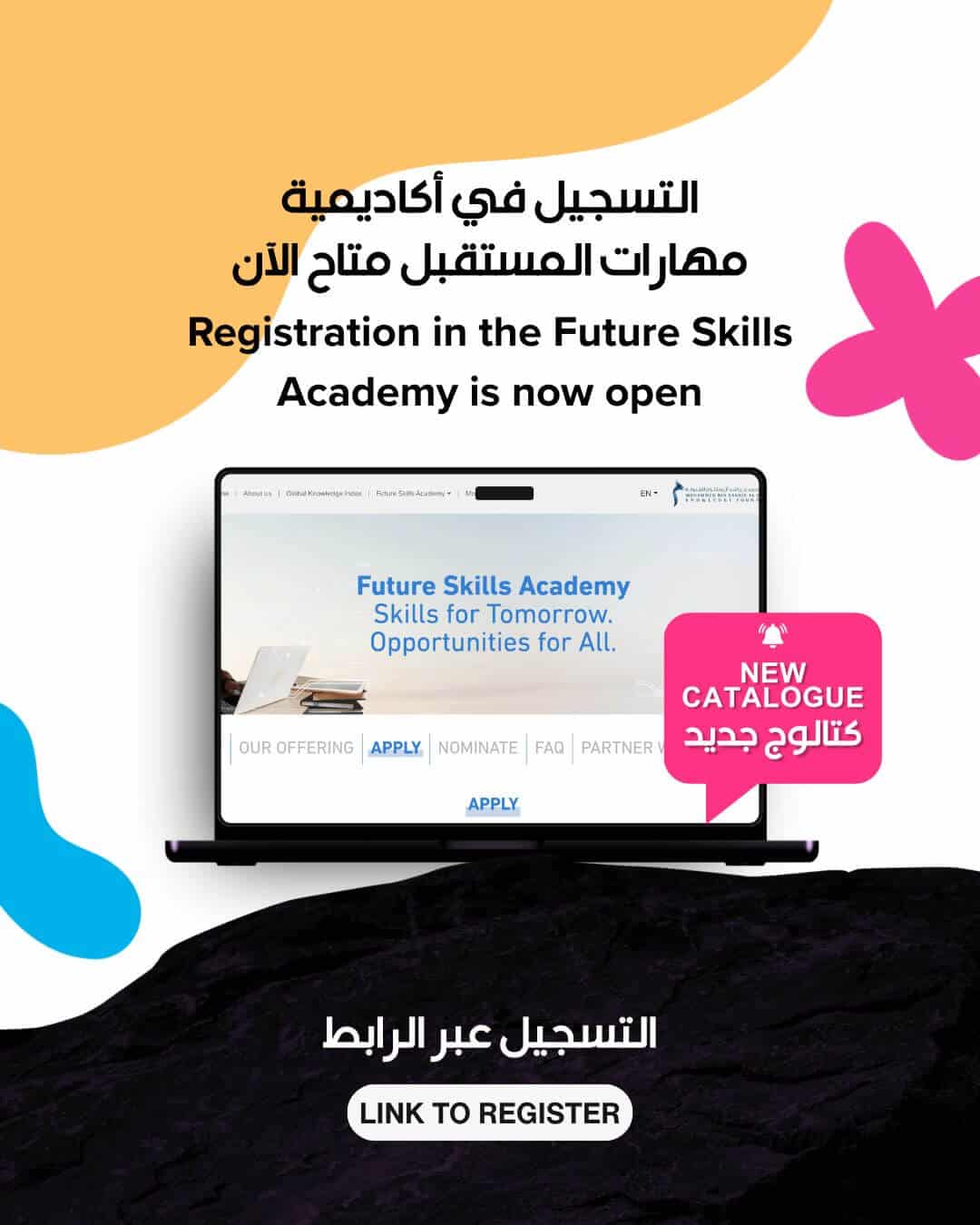
Unlock your ultimate career potential with the Future Skills Academy, a massive joint initiative by the United Nations Development Programme (UNDP) and the Mohammed bin Rashid Al Maktoum Knowledge Foundation (MBRF). Gain elite, fully-funded global certifications from the world’s top tech giants and universities to drive the Arab region’s digital and economic transformation.
Core Learning Pathways & Available Programs
The academy offers a massive catalog of 77 in-demand roles and specializations, strictly divided into three comprehensive tracks.
- Track 1: Transferable & Foundational Skills: Build your core professional foundation. This track includes Soft Skills & Critical Thinking (IBM, UC Davis), Foundational Digital Skills (Digital Safety, ChatGPT Data Analysis by Vanderbilt University), Career Readiness (LinkedIn Networking, Interviewing), and comprehensive Business English for Professional Success (Voxy, University of Washington). It also features advanced Leadership and “Future Thinking” pathways (Dartmouth College, Northwestern University).
- Track 2: Entrepreneurial Skills: Scale your business vision. Pathways include the Entrepreneurship Accelerator and Mastery programs, Social Entrepreneurship (Copenhagen Business School), Technology Startup creation (CU Boulder), and specialized modules on Innovative Business Models and Venture Finance.
- Track 3: Advanced/Technical Skills (Reskilling & Upskilling): Dive into hardcore technical roles divided into Level 1 (No previous knowledge) and Level 2 (Good previous knowledge).
- AI & Data Science: Master Machine Learning in Production (DeepLearning.AI), Agentic AI Engineering (RAG, MCP & MERN), and Google/IBM Data Analytics & Engineering.
- Cybersecurity & Cloud: Study Microsoft Cybersecurity Analytics, Cloud Computing at Scale (Duke University), Telco-Cloud architectures, and Cybersecurity GRC Foundations (Macquarie University).
- Software Development & IT: Become a Meta Front-End/Back-End or Android/iOS Developer, or an IBM Full Stack Software Developer.
- Finance, FinTech & Business: Explore the Blockchain Revolution (INSEAD), Strategic Business Analytics (ESSEC), Supply Chain (Rutgers), and Digital Marketing & E-commerce (Google, Meta).
- Health & Sustainability: Study Renewable Energy, Sustainable Cities (Johns Hopkins), Health & Safety Engineering, and Public/Mental Health specializations.
Required Qualifications & Enrollment Rules
- Target Demographic: The initiative is explicitly designed for citizens across the Arab region, welcoming university students, fresh graduates, entrepreneurs, and both public and private sector professionals.
- The “One Program” Rule: Applicants must carefully review the learning catalogs because you are strictly permitted to select and enroll in ONLY ONE learning program.
- Time Commitment: Participants must be fully prepared to commit to the specific duration and weekly hours of their chosen track (programs range from 2 to 6 months, requiring 3 to 10 hours of study per week).
- Application Integrity: You must fill out the online registration form accurately. Failure to complete the required essential information during the registration process will lead to the immediate disqualification of your application.
Technical Edge: Why Agentic AI & Cloud/SDN matters at the Future Skills Academy?
The UNDP and MBRF launched this academy because integrating the digital economy could add $1.6 trillion to the regional GDP. To achieve this, the academy explicitly focuses on ultra-niche tech skills like “Agentic AI Engineering” and “Telco-Cloud Infrastructure.” In the modern corporate sector, standard cloud computing is rapidly evolving into Software-Defined Networking (SDN) to deploy dynamic 5G and enterprise architectures. Similarly, an AI developer who can build “Agentic Workflows”—where multiple AI models autonomously collaborate using RAG (Retrieval-Augmented Generation) and MERN stacks to solve a multi-step business problem—drastically outpaces a standard software engineer. Mastering these exact, high-demand enterprise architectures ensures graduates become the technical backbone of the region’s digital transition.
Recru Eg Golden Advice for the Application
Because the Future Skills Academy strictly enforces the “Choose ONLY ONE Program” rule, your application strategy must be flawless. Do not blindly select a track just because the title sounds impressive. You must align your choice with the academy’s framework of Level 1 (Reskilling) vs. Level 2 (Upskilling). If you have zero coding background, do not apply for a Level 2 track like “Software Architecture for Big Data”; you will fail to meet the rigorous 10-hour weekly assignments and lose the grant. Instead, select a Level 1 Reskilling track like “Google IT Support” or “IBM AI Engineering.” Conversely, if you are an established tech professional, bypass the basics and target a highly specialized Level 2 track like “Cyber Security DevOps.” Choosing the exact track that matches your technical baseline ensures you successfully complete the hours and secure the elite global certification.
Frequently Asked Questions (FAQ)
Q: Can I enroll in multiple technical tracks or pathways simultaneously?
A: No. The official Future Skills Academy rules explicitly state that you can select and register for only one learning program. You must review the catalogs carefully before submitting your final registration.
Q: Are these programs completely free, and who issues the certificates?
A: Yes, this is a fully-funded joint initiative by the UNDP and MBRF. Upon successful completion, learners will obtain professional certificates or specializations directly from global entities like Google, Meta, IBM, DeepLearning.AI, and elite universities worldwide.
Q: How much time do I need to dedicate to my chosen program?
A: The time commitment varies heavily depending on the specific track you choose. For example, Soft Skills tracks may require 3 hours a week for 3 months, while hardcore technical tracks (like Meta iOS Developer) require up to 10 hours a week for 6 months.